Beryl Brookman is now 83. Louise and I have known Beryl as a
Quaker of deep faith and strength of character for the four years we have been
attending the Marazion Meeting. I interviewed Alan Newton, her husband, and wrote
up the outline story of his extraordinary life last year (see the blogpost here);
now it is Beryl’s turn .
 |
| Beryl and Alan in their Gonewoods home in April 2024 |
Beryl Brookman was born in 1942 in Lancashire. Her guardian
angels sprung into action immediately. Unresponsive, the doctor resorted to
giving Beryl, the newborn baby, the ‘kiss of life’, a technique then new to the
world. Beryl had had her first lesson in the art of survival and passed with
flying colours.
Beryl was born into adversity. She was the second child of her mother, Betty and her father’s first and only child. Mum had married Jack who worked on the Manchester Ship Canal and they lived in Manchester. Then in 1939 came a tragedy which was to have such ripple effects. Jack suffered a broken neck in an industrial accident when a load fell on him. As he lay on the ground dying, he turned to his best mate, Henry Tobin, and said: ‘Look after Betty’. Betty was eight months pregnant. Henry was a
good man and married Betty. It was a disaster for both of them. Somehow Beryl emerged as a grounded person through all the confusion and tension of her childhood years. In Beryl’s words, ‘My father got hell because he wasn’t Jack.’ Henry suffered; so too did Beryl. When Jack’s mum visited, she paid scant attention to Henry or Beryl. It was Margaret, the daughter of Betty and Jack - Beryl’s elder sister by around two and a half years, who was fussed over. |
| Betty, Beryl's mother |
Beryl’s dad, Henry, was a lifeline for Beryl. He was gentle,
funny, and hardworking. Beryl’s mother did not approve of them spending time
together but allowed the two of them to make the family breakfast on a Sunday
when her father who had a lovely voice would croon ‘Sailing Down the River’. ‘Bing’
Tobin was in his element and Beryl was happy. Her sister, Margaret, thin and
tall, found it much more difficult to be happy despite her mother’s favours. Beryl
says she saw her smile so seldom.
 |
| Henry, Beryl's father |
Margaret was sent to a private school, Beryl too. Climbing
the social ladder required this financial outlay. Beryl rather liked school and
learning. Margaret did not. The alarm bells began to ring for mother. ‘Don’t
you dare pass that 11 plus examination!’, Beryl was told angrily. Beryl sat
down in the classroom and began to read the exam questions. ‘I know the answer
to that’, she thought – and slipped into rebellion. She passed and was accepted
into Heywood Grammar School for Boys and Girls. Mother was furious and Beryl
was never forgiven. Mother could never let go, though. ‘Don’t get good marks’
became her next line of attack and it worked to an extent. Beryl found herself
in the ‘C’ stream in the Grammar School and coasted along, liking learning yet disguising
her own brightness. But Beryl remained a target. Her homework would be
destroyed, a cup of tea spilt ‘by accident’. As Beryl says, ‘You just accept it
– you know it’s not going to change – you just find ways around it.’
One way of escape was gifted by her dad. From the 1950s all
the cotton mills had pre-school nurseries for the children of their female
workers. Beryl’s dad asked her, ‘How do you fancy working in a nursery during
the school holidays?’ He knew she would jump at the chance – Beryl loved being
with children. ‘Right. I’ll have a word with the mill manager.’ All the
children in the nursery where Beryl soon found herself working were Polish,
except one. No matter. Who needs language skills when you’re running a playgroup filled with
laughter and love.
Back at school, the GCE examinations approached. Mother
issued the formal warning. ‘Don’t think of passing any.’ Beryl was tempted to
obey but couldn’t resist taking and passing English Literature. She did after
all love reading. What now, though? The answer came in the form of the NNEB –
the National Nursery Examinations Board. It offered a two year nursery training
course, home-based, with an additional baby training course. Between the ages
of 16 and 18, Beryl completed the course working in the four mill nurseries in
Rochdale. The way was being paved for a career in nursing. The next step was
made possible by the encouragement of a Health Visitor who saw Beryl’s
potential and her higher education years were spent at the Northern Hospital in
Cheetham Hill following a three year general nursing qualification course. These
were years of liberation since Beryl was required to live in. The hospital was
now her home. She was free of her mother. It was a strict regime – one late-pass
a week and back by 11pm - controlled by fierce matrons, but Beryl loved the
training. She recalls that a couple of secondments at Booth Hall, a specialist children’s
unit for severe burns, were challenging but very rewarding.
It was whilst Beryl was at the Northern Hospital that she
met Ken, a Liverpudlian Catholic and research chemist. They became engaged on
her 21st birthday in 1963 and by 1964 Beryl was fully qualified with
a medal and certificate – and married. Her first post was in a Family Group
Home set up for six children with ‘massive problems’. One of the children had
been taken into care when her parents were found to be running a brothel. Beryl
loved the challenges – and successes. Soon, Ken and Beryl were expecting their
first child. Beryl recalls a health official saying to her, ‘Well, you won’t be
staying here now – you won’t want to bring up your children with these kids’.
That really wasn’t the way Beryl made sense of the world. Her vision was always
inclusive. A year and a week into their marriage, in 1966, Amanda was born and
Beryl began working alternate night shifts. Fortunately, Amanda was a good
sleeper. Amanda was eight months old when her grandad, Henry, visited in secret
and whilst she was playing with his car keys began to complain of heart pains. Henry’s
condition worsened. Beryl borrowed a phone to tell her mother that Henry was very
seriously ill. ‘There’s nothing wrong with him", Betty insisted. Shortly
afterwards, Henry died in hospital. Their second child, Jeremy, arrived two
years later in 1968 and wasn’t such a good sleeper. Both babies were delivered
at home.
Beryl had moved house a number of times as a child and that
pattern of mobility became part of her adult life too. She loved the excitement
and challenge of a new home and making sense of whatever was ‘around the
corner’. Beryl and Ken’s new home had been a derelict farmhouse, near a Roman road.
It was half-built into the hillside with the living room view blocked by earth
and rock – so they moved into a caravan whilst the house was renovated. The bedroom
was moved downstairs with the living room now commanding a fine view of the
moors.
Jemina was born in 1970. Beryl loved being pregnant and
having children but now began to feel a little selfish in a world where so many
children would benefit from being adopted. Ken went along with Beryl’s wish to
explore the adoption path and in 1972 Ben became their adopted fourth child. By
now, Beryl was working in a Leonard Cheshire registered nursing home for the
physically disabled. Having been approved as a potential adopter, she told social
services to just tell her when there was a baby to be collected. Ben is mixed
race with a white mother and Asian father. Later, Ben did contact his birth mother
but that didn’t work out. ‘I don’t want to speak to her again’. She had been so
negative about everything; Ben had been brought up to enjoy life. Two years
after Ben joined the family, Dan – an Anglo-Chinese adoptee – became the fifth child
in the family.
 |
| Beryl and Ben |
 |
| Ben and his daughter, Anya |
 |
| Beryl and Dan in December 2009 |
 |
| Dan in March 1975 |
The wanderlust bit again. Beryl decided she wanted to live in the Orkneys. For the children it would be, in Beryl’s words, ‘a good grounding in a classless society’. A camping holiday there confirmed the choice. It was a dream coming true. The Orkney local paper carried news of a former manse house for sale on Burray, one of the small islands of Orkney. Purchase was through sealed bids. Beryl and Ken’s bid won. By now, Ken was becoming disillusioned with his work at ICI and the family set off for a new life. The old manse was converted into a guest house and restaurant and Beryl who had always loved cooking became a restauranteur. The stage was set for around ten years of life on a remote Scottish island.
The Scottish way of eating, shaped by Scandinavian
influences, meant that the last meal of the day was the High Tea; there was no
pattern of going out for a main meal. Beryl’s venture had risks. Soon, though,
there were two permanent guests – oil-field workers – who started their day
with 5.30 breakfasts. Then Beryl would serve the children and Ken their
breakfasts and then came the turn of any other guests who were staying. There was
also the cow, and the pigs, ducks, hens and goats to attend to on the small
holding that was now part of their next house on Burray – a rather respectable ‘Butt
and a Bien’ property with a ‘bit in the middle’. The family enterprise was succeeding.
Some days, Billy Peace who provided the Burray coach, bus and taxi service would
phone and order morning coffee and evening tea for his day-trippers – his coach
had room for fifty-one.
Life on Orkney was busy and fulfilling and the children
flourished. All five still maintain strong contacts with Orkney and its people
and life. Amanda, Beryl’s first born child, was ten when the Orkney move was
made in 1976 and her Scottish schooling experience was excellent. In 1983, she
took up her place in Cambridge, reading modern languages. Ken, however, quite
soon decided he would go to Flotta to work on the oil rigs and eventually departed
to Saudi Arabia for employment. He had always been more materialistic than
Beryl. Their marriage was now in terminal decline and ended in divorce in the 1990s.
In 1986, Beryl began the next phase in her life journey. She
was now 44 and applied for and, a little to her own surprise, secured the post
of matron at CARE – Cottage and Rural Enterprises – based in Preston back in
Lancashire. This was an institution specialising in young adults with learning
difficulties. Beryl was in her element. From there she moved on to become the
Principal at the National Autistic Society on the Wirral where again she brought
her own direct and inspired style of management. She remembers one young man,
Mark, who was on the extreme end of the autism spectrum, very tall and at first
happy. Then something started to go wrong and he began to lash out. The
children would see the bruises on Beryl’s legs where Mark had kicked her as she
restrained him and knew that Mark had lost the plot again. ‘We’re doing
something wrong’, Beryl insisted, speaking to Gordon, the manager. ‘We must work out what it is’. In the end, the
truth emerged; Mark was being bullied by
a new staff member.
Beryl was very good at her work and in her mid-fifties was
head-hunted to become Principal of the Grange Centre in Bookham, Surrey. This
was an institution with a distinctly upper-class Council of Management, who had
enough good sense to appreciate Beryl’s expertise and wisdom. Beryl remembers
one of the titled ladies on the Council board exclaiming, ‘We do have fun with
you here!’. These ladies also listened to Beryl when she asked them how much
they paid their own domestic servants and then pointed out that the domestic
servants in the Grange Centre were earning much less. They got the message and
introduced a new fair pay policy. Beryl as Principal had the Bursar and the
Secretary as the other key figures in the team. Politely but firmly, the Bursar
was made to relinquish her sole control over the petty cash. Sometimes power
struggles need to be fought.
The Grange Centre today is still going strong and supports
135 disabled people. Its history is remarkable having been founded in
Leicestershire in 1927 as the School of Stitching and Lace in order to provide
needlework and training for disabled women. In 1938 the School moved to the
Grange at Bookham in Surrey and continued its policy of selling some of its products
to high-end customers, including royalty. The change of name to the Grange
Centre took place in 1972 and in 1992 the Grange Centre took its first male resident
and expanded its skills base with the introduction of woodwork training.
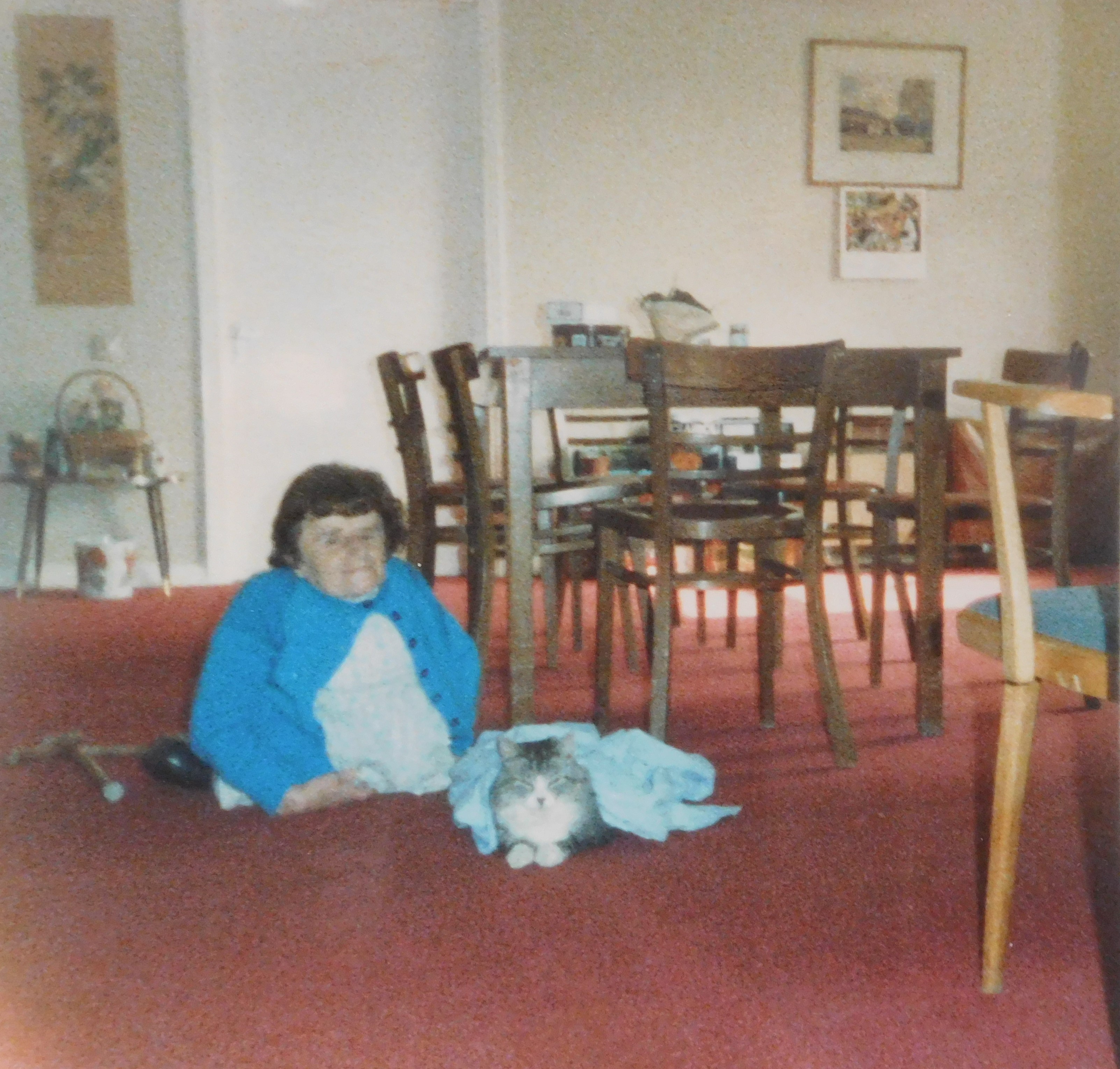
Beryl tells the story of one resident, Enid, who made quite
an impact. Enid was 33 inches tall and a remarkable lady, determined to learn
sewing skills. Enid loved watching professional wrestling on TV and Big Daddy
was her absolute hero. Beryl was able to take Enid to watch Big Daddy perform
in person and remembers Big Daddy making his ceremonial entrance striding towards
the ring, pausing, and then moving over to where Enid was sitting to greet her.
Beryl had to lean forward to make that embrace possible. A lovely moment – and
made even more powerful because years later Beryl shared this story with Alan
to discover that Alan had been watching that very same moment on TV himself.
 |
| Enid |
Unfortunately, the curse of ME/CFS (Myalgic Encephalomyelitis/Chronic
Fatigue Syndrome) was now beginning to afflict Beryl and she retired at 60 in
2002. Her arrival in Cornwall was shaped by her friendship with Betty and
Donald Mason. Donald was from Plymouth, a former Methodist minister and a
socialist who had found his full spiritual meaning with the Quakers. He and
Betty had retired in Cornwall and Beryl followed their path. When Beryl’s ME
symptoms settled and became more manageable, she became matron/manager of Benoni
Nursing Home in St Just and loved her time there. Marazion and Alan Newton then
completed the setting for this current stage in Beryl’s odyssey.
Beryl has always had the gift of friendship. She has made
lasting connections with many people in the course of her life. Joyce is one of
those friends.
 |
| Beryl and Joyce |

I found this searching for Henry Tobin, who is named in my property deeds. I'm pretty sure Beryl's dad Henry is the same Henry. If you can confirm that one of his properties was Thornham Old Road, Royton it will be him. How exciting.
ReplyDeleteHi Deborah,
DeleteIt is indeed the same Henry Tobin - Beryl too is excited at discovering this connection. Here is Beryl and Alan's email address - gonewwoods@outlook.com - but there is no computer at home and Alan only responds once a week. If you could give me/Alan and Beryl your email that might be a more effective way forward - Beryl would love to ask some questions and give more information.
I'm thrilled! My email is deborah@deadgoodwithwords.co.uk
Delete